

News Details
30
2026
-
01
How to Choose the Right Automatic Door Sensor | Complete Buying Guide 2026
Learn how to choose the right automatic door sensor for your business. Compare motion, infrared, and safety sensors with expert tips on performance, safety, and installation.
Automatic door sensors are a critical component in modern entrance systems, directly impacting safety, accessibility, and user experience. Whether you’re specifying equipment for a commercial facility, retail store, hospital, or industrial site, selecting the right sensor requires a clear understanding of detection technologies, application scenarios, and compliance requirements.
This guide breaks down the key factors you need to evaluate when choosing an automatic door sensor.
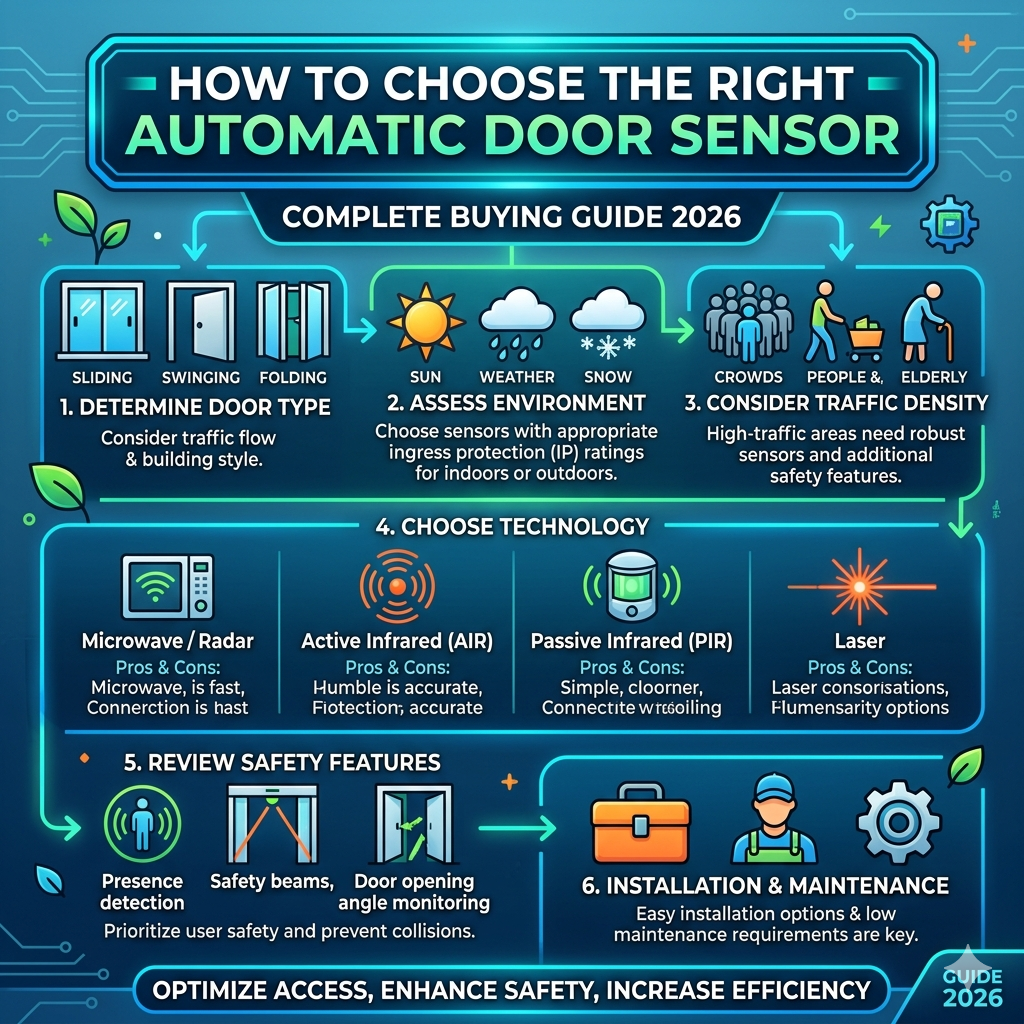
1. Understand the Different Types of Sensors
The first step is to identify which sensing technology best suits your application:Motion Sensors (Radar / Microwave)
Detect movement using microwave signals
Ideal for: high-traffic entrances, supermarkets, office buildings
Pros: wide detection range, reliable in most weather conditions
Cons: may trigger unnecessarily (e.g., passing traffic)
Infrared Sensors (Active/Passive)
Detect heat or reflected infrared signals
Ideal for: pedestrian-focused entrances
Pros: precise detection, reduced false triggers
Cons: performance can vary with ambient temperature
Safety Sensors (Presence Detection)
Typically use infrared or laser grids to detect stationary objects
Ideal for: preventing doors from closing on people or objects
Pros: essential for safety compliance
Cons: must be paired with activation sensors
Laser Sensors
Use LiDAR-like technology for highly accurate detection
Ideal for: complex environments (airports, hospitals, narrow entrances)
Pros: precise object recognition and filtering
Cons: higher cost
2. Define Your Application Scenario
Different environments demand different sensor configurations:
Retail Stores: Fast response and wide detection to handle foot traffic
Hospitals: High safety standards, precise detection (wheelchairs, beds)
Industrial Facilities: Durability, resistance to dust and vibration
Office Buildings: Balanced performance with energy efficiency
Ask yourself:
Is the traffic mostly pedestrian or mixed (carts, forklifts)?
Is the environment indoor or outdoor?
Are there environmental challenges (rain, snow, dust, sunlight)?
3. Consider Installation Environment
Environmental conditions significantly influence sensor performance:
Outdoor Installations:
Require weatherproof sensors (IP-rated housing), resistance to rain, fog, and temperature fluctuationsIndoor Installations:
Focus on detection accuracy and aestheticsMounting Height:
Ensure the sensor supports your door’s installation height (typically 2.2–4 meters)Lighting Conditions:
Strong sunlight or reflections can affect infrared sensors
4. Evaluate Detection Area and Adjustability
A high-quality automatic door sensor should allow flexible configuration:
Adjustable detection range (depth and width)
Directional detection (ignore cross traffic)
Sensitivity tuning to reduce false triggers
For example:
Narrow entrances benefit from focused detection zones
Wide entrances require broader coverage
5. Safety and Compliance Requirements
Safety is non-negotiable. Ensure your sensor meets relevant standards such as:
EN 16005 (Europe) for pedestrian door safety
ANSI/BHMA standards (North America)
Look for:
Presence detection capability
Anti-pinch protection
Redundancy in critical applications
6. Integration with Door Systems
Check compatibility with your automatic door system:
Voltage requirements (e.g., 12–24V DC)
Output signals (relay, NO/NC)
Compatibility with sliding, swing, or revolving doors
Advanced sensors may also support:
AI-based object recognition
Smart building integration (IoT systems)
7. Durability and Maintenance
Long-term reliability affects total cost of ownership:
Choose sensors with industrial-grade components
Look for low-maintenance designs
Check manufacturer reputation and warranty
In harsh environments, prioritize:
Dustproof and waterproof ratings (IP65 or higher)
Vibration and impact
8. Budget vs Performance
While cost is always a factor, the cheapest option may not be the most cost-effective:
Low-cost sensors → higher false trigger rate, shorter lifespan
Premium sensors → better accuracy, lower maintenance, improved safety
A balanced approach:
Use high-end sensors for critical entrances
Standard sensors for low-risk areas
9. Manufacturer and Technical Support
Selecting the right supplier is as important as the product itself:
Do they offer technical documentation and installation guides?
Is after-sales support responsive?
Can they provide OEM/ODM customization if needed?
Reliable manufacturers will also help you optimize sensor settings for your specific project.
Conclusion
Choosing the right automatic door sensor is not just a technical decision—it’s a strategic one that affects safety, efficiency, and user experience.
To summarize, focus on:
Matching sensor technology to your application
Evaluating environmental conditions
Ensuring compliance with safety standards
Prioritizing adjustability and reliability
By carefully assessing these factors, you can select a sensor solution that delivers optimal performance and long-term value for your project.


Contact Information
Add: No.991 Xingxiu Road,Taiwanese Investment Zone, Quanzhou, Fujian Province,P.R.China
Tel: +86 136 1606 8720
E-mail: [email protected]
friendly links: GatePartsHub gate operator accessories