

News Details
30
2026
-
01
Automatic Door Sensor vs Motion Sensor: What’s the Difference?
Learn the difference between automatic door sensors and motion sensors. Discover how each works, their roles in safety, and which is best for your door system.
When selecting components for an automatic door system, many people confuse “automatic door sensors” with “motion sensors.” While the terms are often used interchangeably, they are not the same. Understanding the distinction is critical for proper system design, safety compliance, and performance optimization.
This article clarifies the differences between automatic door sensors and motion sensors, how each works, and when to use them.
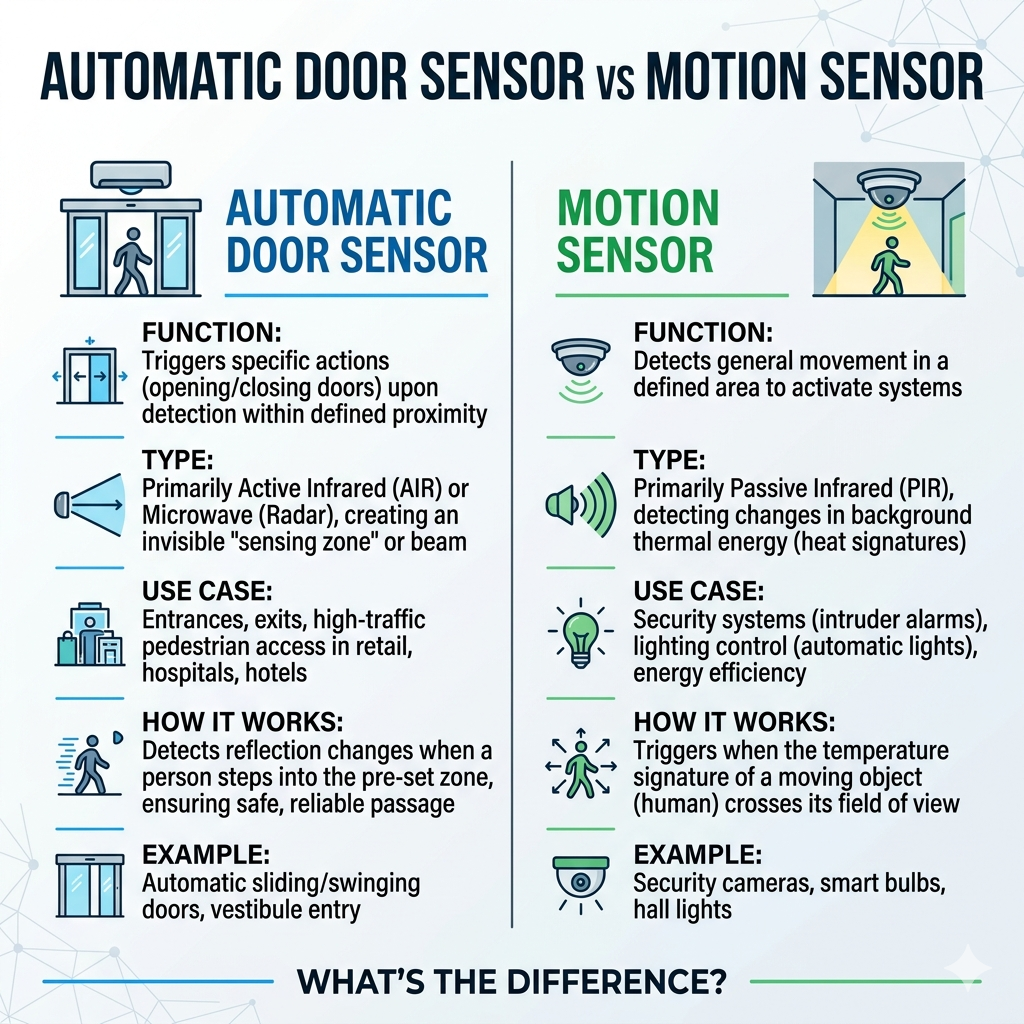
What Is an Automatic Door Sensor?
An automatic door sensor is a broad category of sensors specifically designed for door automation systems. These sensors are responsible for both activating the door and ensuring safe operation.
Automatic door sensors typically fall into two main functional groups:
1. Activation Sensors
These sensors detect approaching users and trigger the door to open.
Microwave sensors
Passive infrared (PIR) sensors
Radar-based sensors
2. Safety Sensors
These sensors ensure the door does not close on a person or object.
Active infrared presence sensors
Light curtain sensors
Laser safety sensors
In other words, an automatic door sensor system includes both motion detection and presence detection technologies, working together for full functionality.
What Is a Motion Sensor?
A motion sensor is a specific type of sensor designed solely to detect movement within a defined area.
It is commonly used in:
Automatic doors (as activation sensors)
Security systems
Lighting control systems
Motion sensors detect movement using technologies such as:
Microwave radar (based on the Doppler Effect)
Passive infrared (heat detection)
Ultrasonic waves
However, motion sensors do not inherently provide safety protection. They only trigger actions when movement is detected.
Key Differences: Automatic Door Sensor vs Motion Sensor
1. Scope and Definition
Automatic Door Sensor: A complete category covering all sensors used in door systems (activation + safety)
Motion Sensor: A single function device that detects movement only
Think of it this way:
A motion sensor is a subset of automatic door sensors.
2. Functionality
| Feature | Automatic Door Sensor | Motion Sensor |
|---|---|---|
| Detects motion | ✅ Yes | ✅ Yes |
| Detects presence (stationary objects) | ✅ Yes (with safety sensors) | ❌ No |
| Prevents door from closing on people | ✅ Yes | ❌ No |
| Triggers door opening | ✅ Yes | ✅ Yes |
3. Safety Role
Automatic doors must comply with safety standards in regions like Europe (EN 16005) and the US (ANSI/BHMA).
Automatic door sensors include safety components that:
Detect stationary people in the doorway
Prevent accidental closing
Motion sensors alone cannot:
Detect someone standing still
Guarantee safe door operation
This is why relying only on motion sensors can create serious safety risks.
4. Technology Used
Motion Sensors:
Microwave radar
PIR (Passive Infrared)
Ultrasonic
Automatic Door Sensors (full system):
Motion detection (microwave, PIR)
Active infrared presence detection
Laser scanning technology
Light curtains
5. Application Differences
Motion Sensors Only:
Simple door activation in low-risk environments
Lighting systems
Alarm systems
Automatic Door Sensor Systems:
Hospitals (high safety requirements)
Airports and public buildings
Retail entrances with heavy foot traffic
Industrial automatic doors
Why the Difference Matters
1. Safety Compliance
Using only motion sensors in an automatic door system may violate safety regulations and increase liability.
2. User Experience
Without presence detection:
Doors may close too quickly
Users may feel unsafe or inconvenienced
3. System Reliability
A complete automatic door sensor system:
Reduces false triggers
Improves detection accuracy
Handles both moving and stationary objects
Real-World Example
Imagine a supermarket entrance:
A motion sensor detects a customer approaching → door opens
The customer stops in the doorway to check their phone
If only a motion sensor is used:
The system may think the area is clear
The door could start closing
With a complete automatic door sensor system:
Presence sensors detect the stationary person
The door remains open until the area is clear
How to Choose the Right Solution
When selecting sensors for automatic doors, consider:
Traffic volume: High traffic requires dual technology or advanced sensors
Safety requirements: Always include presence detection
Environment: Outdoor vs indoor affects sensor choice
False trigger tolerance: Dual tech sensors reduce interference
Best practice:
Use a combination of motion detection + safety presence sensors rather than relying on a single technology.
Conclusion
The difference between an automatic door sensor and a motion sensor comes down to scope and functionality.
A motion sensor detects movement and triggers door opening
An automatic door sensor system includes both motion detection and safety mechanisms to ensure reliable and compliant operation
For any commercial or public installation, a complete sensor system is not optional—it’s essential for safety, performance, and regulatory compliance.


Contact Information
Add: No.991 Xingxiu Road,Taiwanese Investment Zone, Quanzhou, Fujian Province,P.R.China
Tel: +86 136 1606 8720
E-mail: [email protected]
friendly links: GatePartsHub gate operator accessories