

News Details
30
2026
-
01
How Laser Safety Sensors Work in Automatic Doors | Complete Guide
Learn how laser safety sensors work in automatic doors using Time-of-Flight technology. Discover benefits, applications, and why they outperform infrared sensors for safety and precision.
Automatic doors are widely used in commercial buildings, hospitals, airports, and retail environments. Ensuring user safety while maintaining smooth operation is critical—and this is where laser safety sensors play a vital role.
In this article, we’ll break down how laser safety sensors work, their key components, and why they are becoming the preferred choice over traditional infrared sensors.
What Is a Laser Safety Sensor?
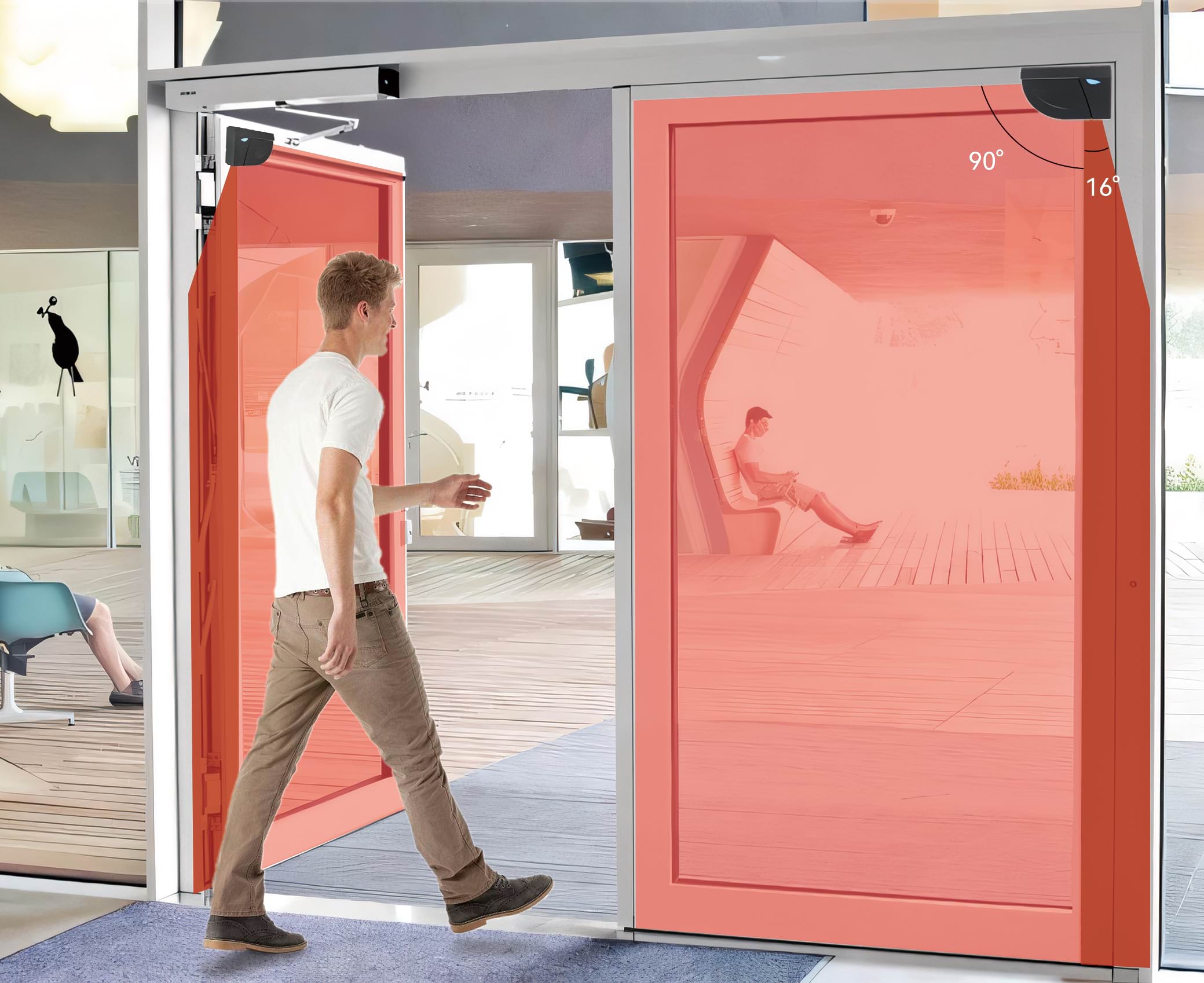
A laser safety sensor is an advanced detection device used in automatic doors to monitor the surrounding area and prevent accidents. Unlike traditional sensors that rely on infrared beams, laser sensors use laser-based distance measurement technology to detect motion, presence, and obstacles with high precision.
These sensors are typically mounted above or near the door and continuously scan the detection zone in front of the door opening.
How Laser Safety Sensors Work
Laser safety sensors operate based on a principle known as Time-of-Flight (ToF).
1. Emission of Laser Beam
The sensor emits a focused laser beam (usually invisible and eye-safe) toward the ground or detection area.
2. Reflection from Objects
When the laser beam hits an object—such as a person, cart, or vehicle—it reflects back to the sensor.
3. Distance Calculation
Using Time-of-Flight technology, the sensor calculates the distance by measuring how long it takes for the laser beam to return.
4. Detection & Decision
The sensor processes this data in real time to determine:
Presence of a person or object
Movement direction
Speed and position
5. Triggering Door Action
Based on the detection:
The door opens when someone approaches
The door remains open if someone is in the threshold area
The door prevents closing if an obstacle is detected
Key Technologies Behind Laser Sensors
Time-of-Flight (ToF)
This is the core technology enabling accurate distance measurement. It ensures fast response times and precise detection even in complex environments.
3D Detection Field
Unlike traditional sensors, laser sensors can create a 3D detection zone, allowing them to:
Differentiate between floor and objects
Adapt to uneven surfaces
Detect stationary and moving objects
Background Suppression
Laser sensors can ignore static backgrounds (like walls or floors), reducing false triggers.
Advantages of Laser Safety Sensors
1. High Precision Detection
Laser sensors offer millimeter-level accuracy, making them ideal for high-traffic environments.
2. Enhanced Safety
They significantly reduce the risk of:
Door collisions
Injuries to pedestrians
Damage to goods or equipment
3. Stable Performance in All Conditions
Unlike infrared sensors, laser sensors are less affected by:
Sunlight
Temperature changes
Reflective surfaces
4. Flexible Installation
They can be configured for:
Sliding doors
Swing doors
Industrial gates
Platform screen doors
Laser vs Infrared Sensors: What’s the Difference?
| Feature | Laser Sensors | Infrared Sensors |
|---|---|---|
| Detection Method | Time-of-Flight (distance) | Beam interruption |
| Accuracy | Very high | Moderate |
| Environmental Impact | Low | High |
| Detection Type | Presence + motion | Motion mainly |
| False Triggers | Minimal | More frequent |
Common Applications
Laser safety sensors are widely used in:
Automatic sliding doors
Industrial warehouse doors
Hospital entrances
Airport terminals
Retail stores
Smart buildings
They are especially valuable in environments where safety, reliability, and precision are critical.
Why Choose Laser Safety Sensors for Automatic Doors?
As automation technology evolves, safety requirements are becoming stricter. Laser safety sensors provide a future-proof solution by combining precision, reliability, and adaptability.
For manufacturers and facility managers, upgrading to laser sensors means:
Improved compliance with safety standards
Better user experience
Reduced maintenance and operational risks
Conclusion
Laser safety sensors represent a significant advancement in automatic door technology. By leveraging Time-of-Flight measurement and intelligent detection algorithms, they ensure doors operate safely and efficiently in any environment.
As demand for smarter and safer buildings grows, laser sensors are quickly becoming the industry standard for automatic door safety systems.


Contact Information
Add: No.991 Xingxiu Road,Taiwanese Investment Zone, Quanzhou, Fujian Province,P.R.China
Tel: +86 136 1606 8720
E-mail: [email protected]
friendly links: GatePartsHub gate operator accessories