

News Details
30
2026
-
01
Types of Automatic Door Sensors Explained: How They Work & Why They Matter
Discover the different types of automatic door sensors, including microwave, infrared, and pressure mats. Learn how each sensor works, their unique applications, and why they're crucial for modern door systems, safety, and energy efficiency.
Automatic doors have become an indispensable part of modern architecture, offering convenience, accessibility, and energy efficiency across a myriad of settings. While the seamless opening and closing of these doors might seem effortless, a sophisticated network of sensors is quietly at work, detecting presence and movement to ensure smooth operation.
But not all automatic door sensors are created equal. Different technologies are employed, each with unique strengths and ideal applications. Understanding these variations is key to appreciating the intelligent design behind every automatic door. Let Let's explore the primary types of automatic door sensors and how they function.
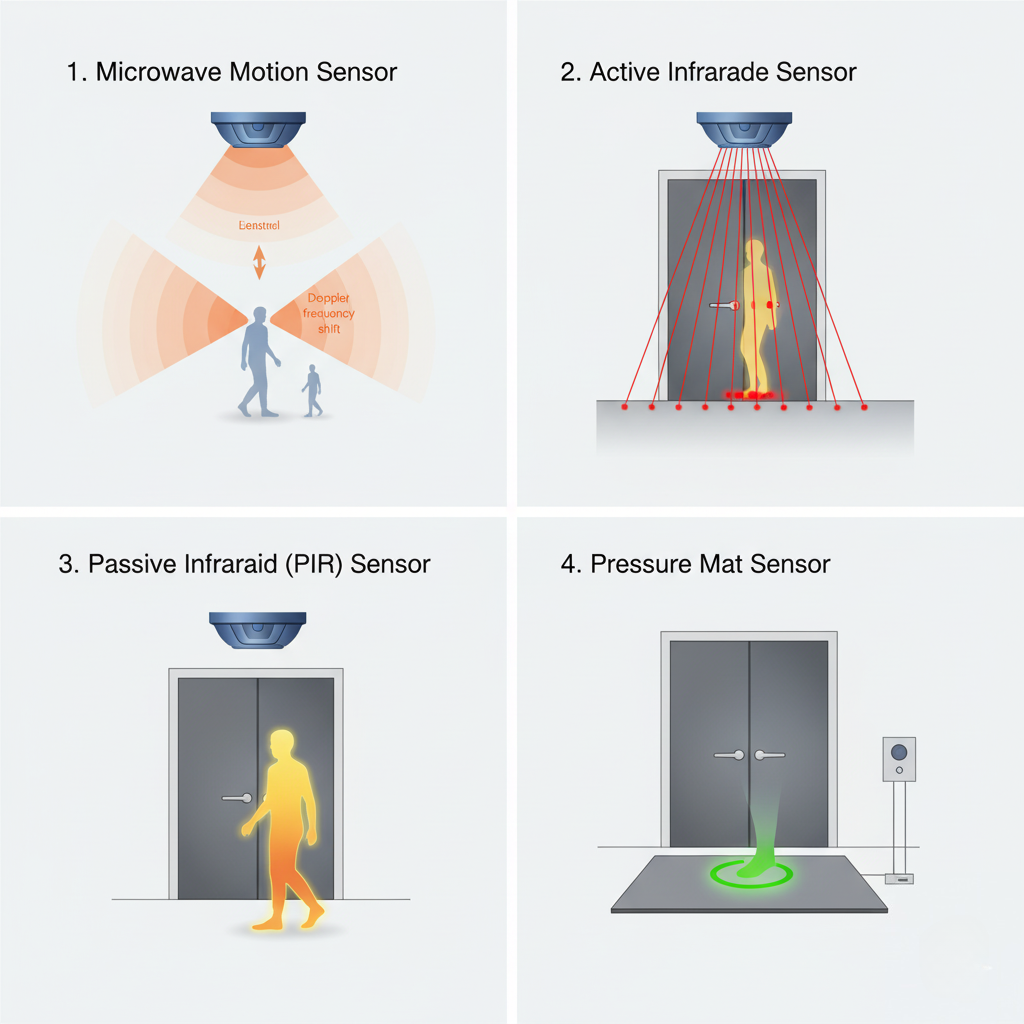
1. Microwave (Radar) Motion Sensors
Microwave sensors are perhaps the most common type used for door activation. They work on the principle of the Doppler effect, which is the change in frequency or wavelength of a wave in relation to an observer who is moving relative to the wave source.
How they work:
Emission: The sensor emits continuous microwave (radar) signals into a defined detection zone.
Detection: When a person or object moves into this zone, the microwaves reflect off them and return to the sensor.
Frequency Shift: If the object is moving, the frequency of the reflected waves will be slightly different from the emitted waves.
Trigger: The sensor detects this frequency shift and interprets it as movement, triggering the door to open.
Key Characteristics & Applications:
Wide and adjustable detection fields: Can be configured to cover large areas, making them ideal for high-traffic entrances like supermarkets, airports, and department stores.
Excellent for motion detection: Primarily designed to detect approaching movement rather than stationary presence.
Unaffected by temperature: Changes in ambient temperature or light conditions do not impact their performance.
Can detect through some materials: While generally focused on the opening, they can sometimes detect through thin, non-metallic barriers, which requires careful setup to avoid unintended activation.
Directional capabilities: Advanced models can be set to detect movement only in specific directions (e.g., approaching the door, but not walking parallel to it), optimizing energy usage.
2. Infrared Sensors
Infrared (IR) sensors are another widely used category, often employed for both activation and, critically, for safety. There are two main sub-types:
a) Active Infrared Sensors
How they work:
Emission & Reception: Active IR sensors emit invisible infrared light beams. These beams are typically projected downwards to create a "curtain" or grid of detection directly in the door's path.
Interruption: When a person or object breaks one or more of these infrared beams, the sensor detects the interruption.
Trigger: This interruption signals the door's control unit, either to activate the door (if used for activation) or, more commonly, to hold the door open or reverse its closing motion (for safety).
Key Characteristics & Applications:
Precise presence detection: Excellent for detecting if someone is standing still in the doorway, preventing the door from closing on them.
Safety Critical: Primarily used as "safety curtains" to comply with automatic door safety standards (e.g., EN16005, ANSI A156.10).
High reliability in door threshold: Provides a robust safety zone right where it's needed most.
Less prone to false triggers from outside the immediate door area.
Can sometimes be affected by strong direct sunlight if not properly shielded.
Best for: Safety applications to prevent impact, or for activation in areas requiring very precise, close-range detection where only objects directly in the door's path should trigger it.
b) Passive Infrared (PIR) Sensors
How they work:
Detection of Heat Signatures: Unlike active IR, PIR sensors do not emit any infrared light. Instead, they passively detect changes in the infrared radiation (heat) emitted by living beings.
Movement Required: When a warm body moves into the sensor's field of view, it registers the change in the heat pattern.
Trigger: This change in heat signature activates the door.
Key Characteristics & Applications:
Energy efficient: Since they don't emit their own signals, they consume less power.
Good for general motion detection: Can cover a broader area than active IR.
Sensitive to temperature changes: Their performance can be affected by ambient temperature fluctuations, especially in very hot or very cold environments, as the contrast in heat signatures might be reduced.
Not typically used for primary safety: Less precise for holding doors open than active IR.
Best for: Less critical motion detection, often found in residential automatic doors or as supplementary sensors.
3. Presence Sensors (Pressure Mats/Weight Sensors)
While less common in new installations due to advancements in overhead sensors, pressure mats represent one of the earliest forms of automatic door activation.
How they work:
Physical Pressure: These sensors are typically embedded in floor mats positioned directly in front of the automatic door.
Switch Activation: When sufficient weight (e.g., a person stepping on it) is applied to the mat, it activates an internal pressure switch.
Signal to Door: This switch sends an electrical signal to the door's control unit, causing it to open.
Continuous Presence: As long as pressure is maintained on the mat, the door will remain open, ensuring safety for stationary individuals.
Key Characteristics & Applications:
Reliable for presence: Excellent at ensuring the door stays open for someone standing on the mat.
Simple and robust: Less susceptible to electronic interference.
Limited to foot traffic: Only works when stepped on, which can be a limitation for trolleys, wheelchairs that don't pass over the mat, or objects.
Maintenance: Can wear out over time, accumulate dirt, or become a tripping hazard if not properly installed.
Best for: Specific safety zones, older installations, or where a very direct, ground-level activation is desired.
4. Combined Sensors
Many modern automatic door systems leverage a combination of these technologies for optimal performance, efficiency, and safety. A common configuration includes:
Overhead Microwave Sensor: For broad-area motion detection to activate the door as a person approaches.
Active Infrared Safety Curtains: Mounted directly above or to the sides of the door to create a precise safety zone, preventing the door from closing if someone is standing in the threshold.
This multi-sensor approach ensures that the door opens reliably for approaching traffic while also guaranteeing that it remains safely open for anyone present in its immediate path.
The Brain Behind the Operation
Regardless of the sensor type, it's crucial to remember that these sensors are just the "eyes" and "ears" of the automatic door system. They send their signals to a central control unit (a microprocessor), which processes the information, makes decisions (based on programmed logic and safety protocols), and then commands the door's motor to open or close smoothly and safely.
Conclusion
Automatic door sensors are a testament to how intelligent technology can enhance our daily lives. From the expansive reach of microwave motion sensors to the precise safety net of active infrared, each type plays a vital role in creating the seamless, accessible, and safe environments we've come to expect. As technology advances, these sensors will continue to evolve, making our entrances and exits even smarter and more intuitive.


Contact Information
Add: No.991 Xingxiu Road,Taiwanese Investment Zone, Quanzhou, Fujian Province,P.R.China
Tel: +86 136 1606 8720
E-mail: [email protected]
friendly links: GatePartsHub gate operator accessories